Seasonal clothing can occupy valuable wardrobe space for months without being used. Winter sweaters remain on shelves through summer. Light clothing fills drawers during colder months. Spare blankets, jackets and soft textiles can quickly turn storage into a problem of volume rather than quantity.
A better approach is to treat seasonal storage as a simple routine. Sort what you own, clean everything properly, group similar items and compress only the materials that are suitable. The objective is not to hide clothing away. It is to make the next seasonal change easier.
Review what deserves storage space
Do not store every item automatically. Seasonal changes are a useful opportunity to review what you actually wear. Clothing that no longer fits, damaged pieces and garments that have not been used for several seasons may not deserve the same storage space as items you rely on regularly.
Separating items for donation, repair or disposal before storage reduces clutter and makes the remaining collection easier to organise. The most efficient storage system begins with fewer unnecessary objects.
Wash and dry clothing before packing it away
Clothing should be clean and completely dry before long term storage. Small stains can become more difficult to remove over time, and moisture can create odour or damage fabrics. Heavier garments need extra time to dry because the surface can feel ready while moisture remains inside thicker layers.
Check pockets before washing and again before storage. Receipts, tissues and small objects can create stains or leave residue inside garments when they remain there for months.
Group clothing by category
Keeping similar items together makes the next seasonal change faster. Sweaters can remain in one group. Casual jackets can occupy another. Scarves, gloves and smaller accessories can have their own container or bag.
This simple structure prevents the need to open every bag when you want one specific item. It also helps you see how much clothing belongs to each category and whether a storage area is becoming unnecessarily crowded.
Compress suitable soft items
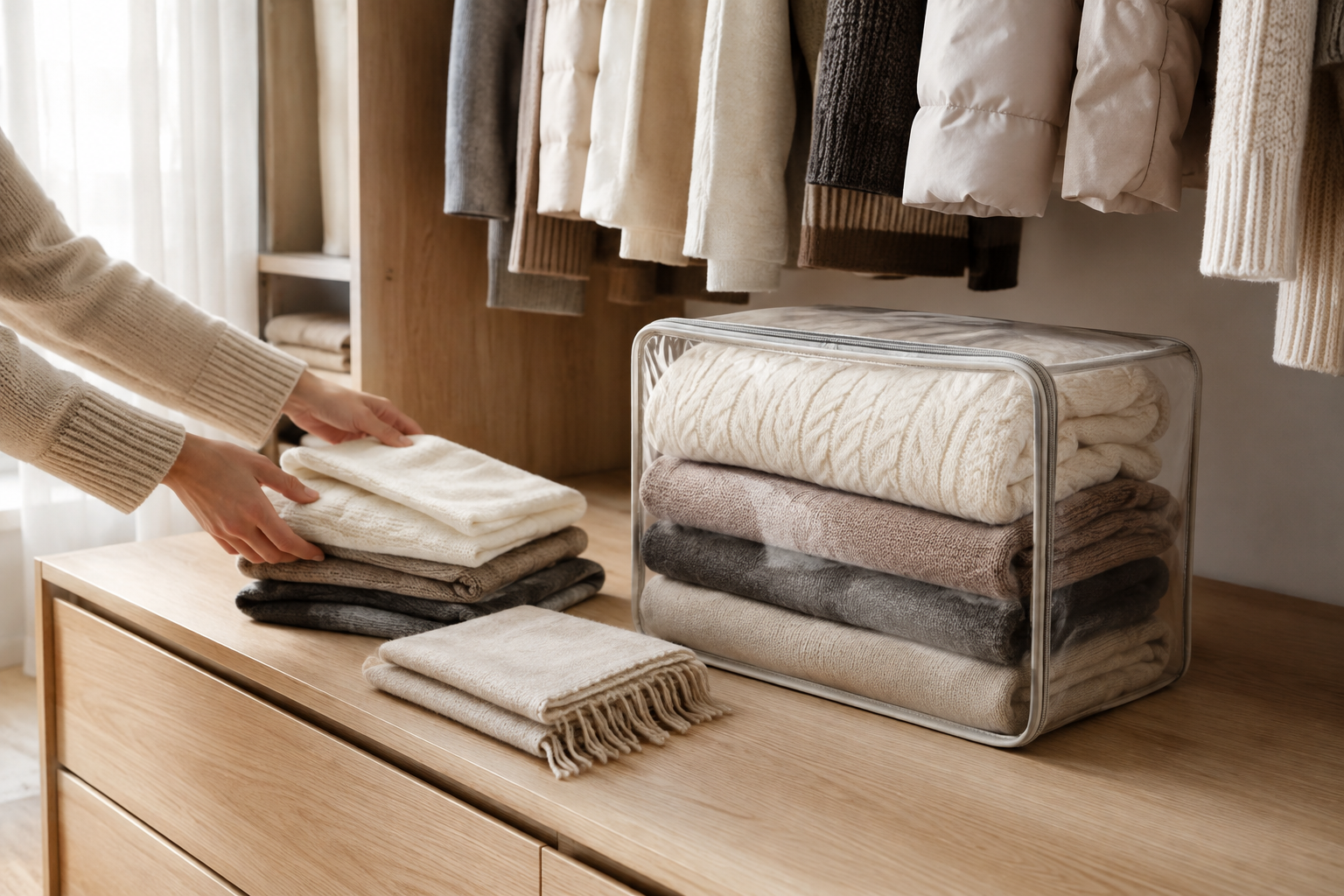
Bulky textiles often contain a large amount of trapped air. Removing some of that air can make seasonal storage more efficient. Sweaters, casual jackets, blankets and other suitable soft items can often be stored in flatter packages when compatible compression bags are used.
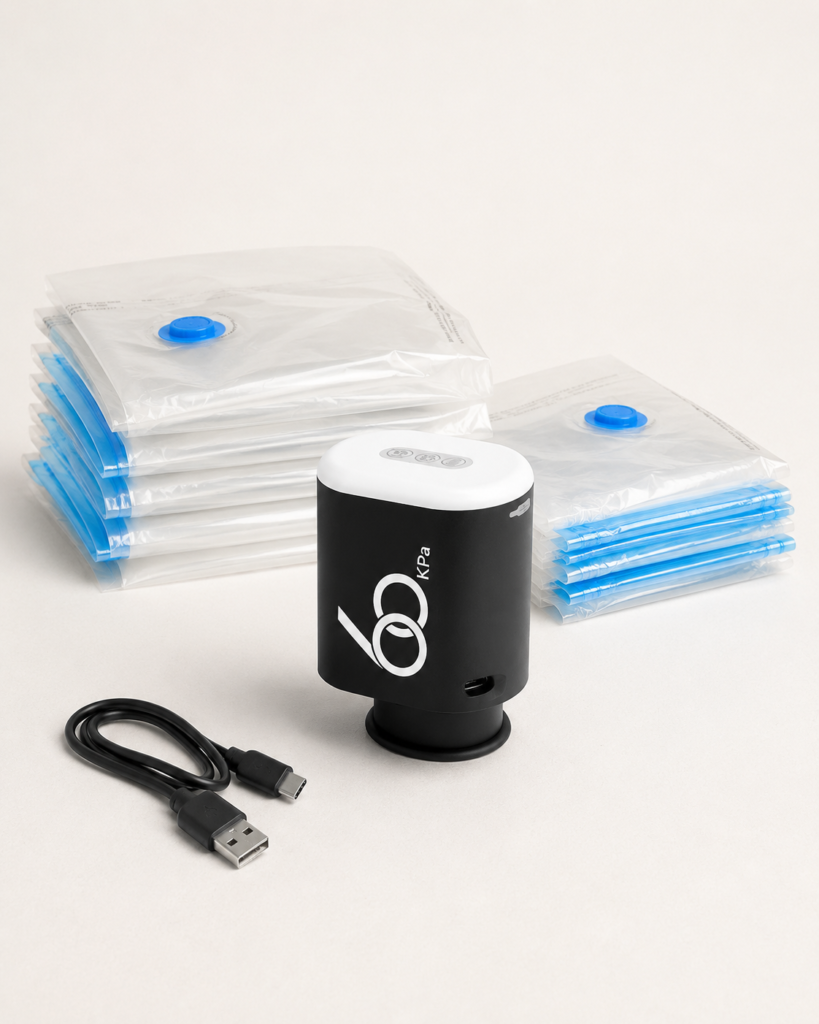
A compact cordless system such as SmartPack Power can be used for travel and home storage. The pump is designed to remove air from compatible bags without requiring a household vacuum. Manufacturer rated suction is up to 60 kPa.
Do not compress every fabric
Compression is not appropriate for every garment. Delicate fabrics, structured clothing and items that rely on loft or shape may need a gentler storage method. Always follow care instructions where they are available.
The same principle applies to travel. Compression is most useful when bulk is the main problem, not as a universal method for every item. Our guide to vacuum compression bags for travel explains this distinction in more detail.
Choose a dry and stable storage location
Saving space is only useful if the clothing is stored in a suitable environment. Keep seasonal items away from excessive moisture, strong heat and direct sunlight. Wardrobe shelves, under bed storage and appropriate containers can all work when the surrounding conditions are dry and stable.
Avoid placing clothing directly against surfaces that are known to become damp. If a storage area has recurring humidity problems, solve that issue before using it for long term textile storage.
Label what you store
A compact storage system is less useful if every bag must be opened to discover what is inside. Use a simple label that identifies the clothing category, season or person. Clear labels also make it easier to return items to the same place next year.
If several bags look similar, record where each category is stored. A short note on your phone can save time when the weather changes unexpectedly and you need one warm layer immediately.
Rotate clothing with intention
When the season changes again, avoid simply swapping one pile for another. Take a few minutes to review the stored clothing before returning it to the wardrobe. Check whether anything needs cleaning, repair or removal.
This turns seasonal storage into a useful maintenance routine rather than a recurring clutter problem. Each cycle becomes easier because the system improves over time.
Make seasonal storage repeatable
Efficient storage is not about making every bag as small as possible. It is about knowing what you own, protecting it correctly and using available space with purpose. Sort first, clean everything, group similar items, compress suitable soft textiles and label each package clearly.
When that routine becomes familiar, wardrobes stay easier to manage and the transition between seasons requires less effort. The same organised approach can also improve travel packing when you need to manage bulky clothing in a limited suitcase. For a practical travel example, see how to pack a carry on for a week without overpacking.